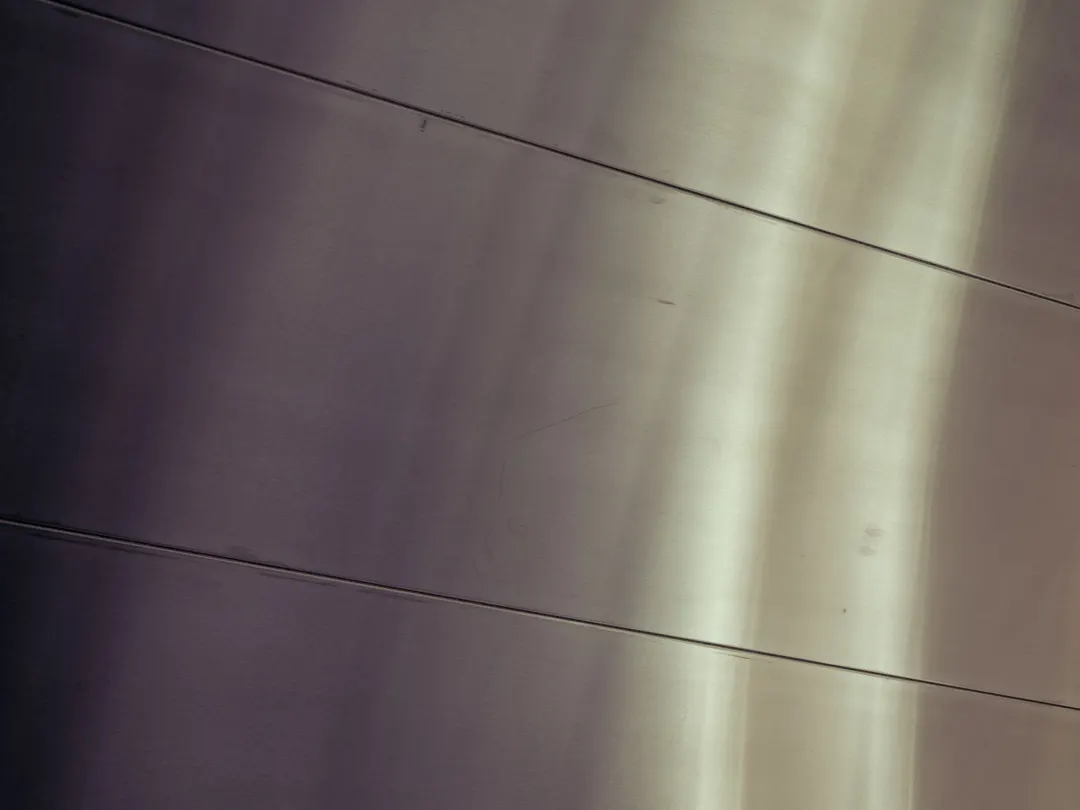
Stainless Steel Finishes: 2B, BA, No.4, Hairline and Mirror
Compare stainless steel surface finishes, from 2B and BA to No.4, hairline and mirror, with typical uses and what to specify in your order.
Read article →
Send the specification, destination and target volume for an order-specific quote.
A stainless steel quote often comes down to one line: 304 or 316. The price gap is easy to see. The cost of choosing wrong is harder to see, because it usually appears later as rust spots on a coastal facade or pits in a process line.
The short answer is that 304 suits many everyday environments, while 316 is the usual step up when chlorides are involved. But 316 is not "marine grade" in every marine situation, and the L versions solve a different problem altogether. This guide explains the differences and how to write them into an inquiry.
Both are austenitic stainless steels. The defining difference is that 316 contains molybdenum, which improves its resistance to pitting and crevice corrosion.
| Property | 304 | 304L | 316 | 316L |
| Chromium (Cr) | About 18–20% | About 18–20% | 16–18% | 16–18% |
| Nickel (Ni) | About 8–11% | 8–12% | 10–14% | 10–14% |
| Molybdenum (Mo) | None specified | None specified | 2–3% | 2–3% |
| Carbon (C), max | 0.07–0.08% | 0.03% | 0.08% | 0.03% |
| Yield strength, min | 205 MPa | 170 MPa | 205 MPa | 170 MPa |
| Tensile strength, min | 515 MPa | 485 MPa | 515 MPa | 485 MPa |
Approximate ASTM A240 values for plate, sheet and strip. Limits have changed between editions and differ in other standards and product forms, so check the edition named in your order.
Stainless steel usually fails in chloride service through localized attack and not by thinning evenly. Small pits form on the surface, or corrosion starts inside a tight gap such as a lap joint or under a gasket. Most of the surface can still look perfect while a pit grows through the wall.
A common way to compare grades is the Pitting Resistance Equivalent Number:
PREN = %Cr + 3.3 × %Mo + 16 × %N
On that basis, 304 sits at around 19 and 316 at around 24–26, depending on actual composition and the nitrogen multiplier used. PREN is useful for ranking grades, but it is only an estimate. It does not tell you how a specific part will behave in service.
Atlas Steels' technical note on pitting and crevice corrosion gives these rough guide levels for water:
| Grade | Warm ambient | At 60°C |
| 304 | About 200 mg/L chloride | About 150 mg/L chloride |
| 316 | About 1,000 mg/L chloride | About 300 mg/L chloride |
Seawater contains about 20,000 mg/L chloride, far above either guide level. The same note describes 304 as susceptible to pitting in seawater above about 10°C. It says 316 is commonly used near ambient seawater, but that its resistance is marginal, so it can be attacked in crevices or if the temperature rises even slightly.
Treat these numbers as a starting point, not a guarantee. Conditions can make a real system much harsher than its water analysis suggests:
Moving up to 316 does not solve every chloride problem. In chloride-containing water above about 60°C, austenitic grades including both 304 and 316 can also be at risk of stress corrosion cracking.
| Situation | Usual starting point | What to check |
| Dry indoor architecture and equipment | 304 | Cleaning chemicals, especially those containing chlorine |
| Food equipment with low salt exposure | 304 | Food-contact rules and the cleaning process |
| Brines, salty foods and chloride cleaning | 316 or 316L | Chloride level, temperature and contact time |
| Coastal facades and railings | 316 | Surface finish, rain washing and a maintenance plan |
| Heavy welding with no post-weld anneal | 304L or 316L | Required strength and the design code |
| Seawater immersion or hot chloride service | Get a specialist review | Whether a duplex or higher-alloy grade is needed |
Coastal sites deserve particular attention. "Tea staining", a brown surface discoloration, is common there. It is usually superficial, but it can be a real problem on visible architectural work. Grade alone does not prevent it, so finish and cleaning matter as well.
The L means low carbon, and it addresses a different risk from chlorides. During welding, the heat-affected zone can form chromium carbides at the grain boundaries. This is known as sensitization, and it can leave the area open to intergranular corrosion. Limiting carbon to 0.03% reduces that risk.
The trade-off is a slightly lower minimum strength, as the table above shows. You will often see material dual-certified as 304/304L or 316/316L, meaning it meets the requirements of both grades. If your design relies on the higher strength and your fabrication needs low carbon, ask for this explicitly.
304 and 316 look identical, so appearance tells you nothing. Use these checks instead:
| Common name | UNS | EN | JIS | GB |
| 304 | S30400 | 1.4301 | SUS304 | S30408 |
| 304L | S30403 | 1.4307 / 1.4306 | SUS304L | S30403 |
| 316 | S31600 | 1.4401 | SUS316 | S31608 |
| 316L | S31603 | 1.4404 | SUS316L | S31603 |
These are close equivalents, not exact matches. Limits differ between standards, so if your specification names one standard, keep that standard in the order and do not simply substitute another.
"Stainless 316" is not enough for an accurate quote. A clear line looks like this:
Stainless steel plate, ASTM A240 316L, 6 × 1500 × 6000 mm, No.1 finish, EN 10204 3.1 certificate, 20 tons, CIF [destination port].
Include these details, and if you are not sure of the grade, describe the service too:
Start with the environment, not the price. 304 is often the sensible choice where chlorides are low, and paying for 316 may add little. Where chlorides, crevices or coastal exposure are real concerns, 316 is the usual starting point, but it still has limits. For seawater or hot chloride service, ask a corrosion specialist before you order.
Shanghai Banzhijia Steel supplies stainless sheet and plate, coil and strip, seamless pipe, welded pipe, square and rectangular tube, round bar, square, flat and hex bar, and angle and channel. Send us your specification or describe the service conditions, and our sales team will reply with a quote. You can also browse the full stainless steel range.
Send the specification, quantity and destination port, and our sales team will prepare a quote.
Compare stainless steel surface finishes, from 2B and BA to No.4, hairline and mirror, with typical uses and what to specify in your order.
Read article →HRB400 and HRB400E have the same minimum strength. Learn what the E adds, how to compare them, and what to check in a rebar inquiry.
Read article →What EN 10204 types 2.1, 2.2, 3.1 and 3.2 mean, how to read a mill test certificate line by line, and the warning signs importers should check.
Read article →